

Whether you’re improving the resilience of critical workloads or upgrading legacy systems; Azure Storage has a solution for you.
Microsoft is redefining what’s possible in the public cloud and driving the next wave of AI-driven transformation for organizations. Whether you’re pushing the boundaries with AI, improving mission-critical resiliency, or modernizing legacy systems with cloud-native solutions, Azure Storage has a solution for you.
Last month at Microsoft Ignite 2025 and KubeCon North America, we showcased the latest innovations in Azure Storage to power your workloads. Here’s a recap of those releases and improvements.
Innovation for the future with AI
Azure Blob Storage provides a single repository base for the entire AI lifecycle, powering everything from ingest and staging to checkpoint management and model deployment.
To enable customers to rapidly train, fine-tune, and deploy AI models, we’ve developed an Azure Blob Storage architecture to scale and deliver exabytes capacity, 10 s Tbps throughput and millions of IOPS per GPU. In this video you can see how one storage account has shrunk 50 Tbps we read the throughput. Azure Blob Storage is also the foundation that enables OpenAI to train and serve models at unprecedented speed and scale.
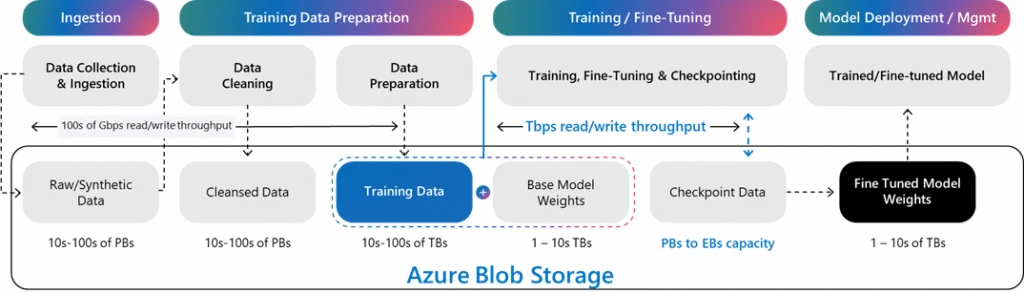
For customers processing AI training data at the scale of terabytes or petabytes, Azure Managed Luster (AMLFS) is a high performance parallel file system providing massive throughput and parallel I/O to keep GPUs continuously fed with data. AMLFS 20 (preview) supports 25 GDP namespaces and up to 512 GBps throughput. Hierarchical Storage Management (HSM) integration improves AMLFS scalability by enabling seamless data movement between AMLFS and your exabyte-scale datasets in Azure Blob Storage. Automatic import (preview) allows you to download only required datasets to AMLFS, and automatic export sends trained models to long-term storage or inference.
Rakuten accelerates the training of Japanese large language models on Microsoft Azure, leveraging Azure Managed Luster, Azure Blob Storage, and Azure Kubernetes Service to maximize GPU utilization and simplify scaling.
Natalie Mao, Vice President, AI & Data Division, Rakuten Group
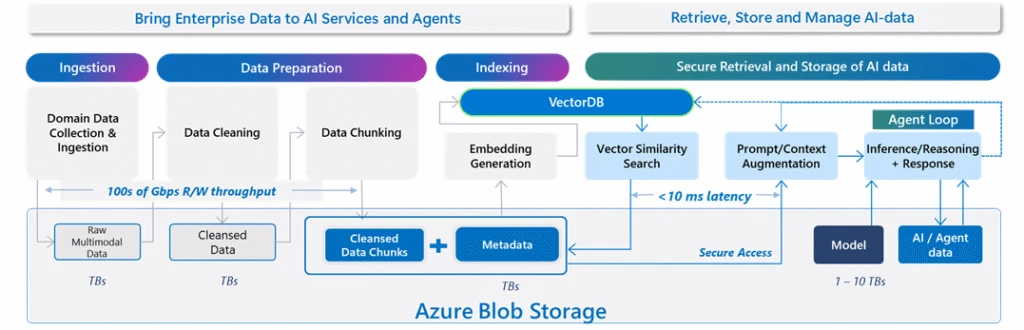
Once the models are trained and tuned, inference takes center stage, providing real-time predictions and insights. Azure Blob Storage provides best-in-class storage for Microsoft AI services, including Microsoft Foundry Agent Knowledge (preview) and AI Search Agents (preview), allowing customers to bring their own storage accounts for full flexibility and control, ensuring enterprise data remains secure and ready for Advanced Retrieval Generation (RAG).
In addition, Premium Blob Storage provides consistent low latency and up to 3x faster loading, which is essential for RAG agents. For customers who prefer open-source AI frameworks, Azure Storage was created LangChain Azure Blob Loader, which provides granular security, memory-efficient loading of millions of objects, and up to 5x faster performance compared to previous community implementations.
Azure Storage is evolving to become an integrated, intelligent, AI-driven platform that simplifies AI data management at exabyte scale. Repository discovery and Co-pilot work together to help you analyze and understand how your data economy is evolving over time with dashboards and natural language questions. With Storage Discovery and Storage Actions, you can optimize costs, protect your data, and manage large datasets with hundreds of trillions of objects used for training and tuning.
Optimizing modern applications with Cloud Native
Modern cloud-native applications require agility. Two principles consistently stand out: elasticity and flexibility. Your storage should scale seamlessly with dynamic workloads – with no operational overhead. The innovations below are designed for the cloud, allowing you to automatically scale, intelligently optimize costs, and deliver the performance needed for modern applications.
Azure Elastic SAN provides cloud-native block storage for scaling and tight Kubernetes integration for fast scaling and multi-tenancy that optimizes costs. With new auto-scaling support, Elastic SAN automatically scales resources as needed, making it easier to manage storage across workloads. Early next year, we will extend Kubernetes integration through Azure Container Storage for Azure Kubernetes Service (AKS) to general availability (GA). These enhancements allow you to maintain familiar hosting environments while layering cloud-native features.
Cloud-native agility is also essential for modern applications built on object storage with the need to optimize cost and performance for dynamic and unpredictable traffic patterns. The intelligent tier (preview) on Azure Blob Storage continuously analyzes access patterns and automatically moves data between tiers.
New data starts in the hot layer. It goes cold after 30 days of inactivity and into cold after 90 days. If the object is reopened, it is promoted back to the Hot state, which automatically keeps the data in the most cost-effective layer. You can optimize costs without sacrificing performance, simplify data management at scale, and focus on building.
Hosting mission critical tasks
Enterprises today run critical workloads that require block storage to deliver predictable performance and uncompromised business continuity. Azure Ultra Disk is our most powerful block storage offering, designed for workloads such as high-frequency trading, e-commerce platforms, transactional databases and electronic health record systems that require exceptional speed, reliability and scalability.
With Azure Ultra Disk, we can confidently scale our platform globally, knowing that performance and resiliency will meet business expectations, that consistency allows our teams to focus on AI innovation and workflow automation rather than infrastructure.
Charles McDaniels, director of systems engineering management for global cloud services, ServiceNow
We know that performance, cost and business continuity remain top priorities for our customers, and we’re raising the bar in every category:
- Performance: We also improved average latency for Azure Ultra Disk by 30% with average latency well below 0.5ms for small IOs on virtual machines (VMs) using Azure Boost. A single Azure Ultra Disk can provide peak performance of 400KB IOPS and 10GB/s throughput. Additionally, with Ebsv6 VMs, both Premium SSD v2 and Azure Ultra Disk can deliver top-of-the-line VM performance of 800KB IOPS and 14GB/s throughput for the most demanding applications.
- Costs: Flexible provisioning for Azure Ultra Disk reduces total cost of ownership by up to 50%, allowing you to independently scale capacity, IOPS, and MB/s with finer granularity.
- Business Continuity: Snapshots instant access lets you instantly back up and restore your workload with exceptional rehydration performance. This distinct experience for Azure Premium v2 and Ultra Disk helps eliminate the operational overhead of monitoring snapshot readiness or resource pre-warming, while reducing recovery, recovery and scaling times from hours to seconds.
Azure NetApp Files (ANF) it is designed to provide low latency, high performance and data management at scale. Its high-volume capabilities have been greatly expanded, providing a more than three-fold increase in capacity per volume 7.2 GDP and a 4x throughput increase to 50 Gbps. Cache volumes bring data and files closer to where users need fast access with a space-efficient footprint. This makes ANF suitable for several high-performance computational tasks such as Electronic Design Automation (EDA), Seismic Interpretation and Visualization, Reservoir Simulation, and Hazard Modeling. Microsoft not only places ANF for mission-critical applications, but also uses ANF for its own silicon design.
Breaking barriers – migrating your storage infrastructure
Every organization’s cloud journey is unique. Whether you need to move your existing environment to the cloud with minimal disruption or plan a complete upgrade, Azure Storage has a solution for you. The Storage Migration Solution Advisor in Copilot can provide recommendations to help simplify the decision-making process for these migrations.
Azure Data Box and Storage Mover simplify the migration path from on-premises and other clouds to Azure. The next generation of Azure Data Box is now GA. Storage Mover is our fully managed data migration service that is secure, efficient and scalable with new capabilities: local NFS shares to Azure Files NFS 4.1, local SMB shares to Azure Blob storage and cloud-to-cloud transfers. The Storage Migration Solution Advisor in Copilot accelerates migration decisions.
For users who are ready to migrate their NAS data, Azure Files now it’s easier than ever. We’ve introduced a new management model that makes sharing files easier and cheaper. In addition, Azure Files now enables the elimination of complex on-premises Active Directory infrastructure or domain controllers with Entra-only identities for SMB shares. With cloud-native identity support, you can now manage user permissions directly in Azure, including external identities for applications such as Azure Virtual Desktop (AVD).
Identity-only support with Azure Files transforms SLB Petrel workflows by removing dependencies on local domain controllers, simplifying identity management and storage infrastructure for globally distributed teams working on complex stack exploration and characterization. This cloud-native architecture allows customers to access SMB shares in an easy and secure way without complex VPN or hybrid infrastructure setup.
Swapnil Daga, Tenant Infrastructure Storage Architect, SLB
ANF Migration assistant simplifies moving ONTAP workloads from on-premises or other clouds to Azure. Behind the scenes, Migration Assistant uses NetApp SnapMirror replication technology to provide efficient, full-fidelity incremental block-level transfers. Now you can consume large datasets without impacting your production workload.
For customers running on-premises partner solutions who want to migrate to Azure using the same partner-provided technology, Azure recently introduced Azure Native offerings with Pure Storage and Dell PowerScale.
To make migrations easier, the Azure Storage migration program connects you to a robust ecosystem of experts and tools. Trusted partners such as Atempo, Cirata, Cirrus Data and Komprise can accelerate the migration of SAN and NAS workloads. This program offers secure, low-risk file, object, and block storage transfers to help businesses unlock the full potential of Azure.
Start the next chapter with Azure Storage
The era of AI-powered transformation is here. Start your journey by exploring Azure’s advanced storage offerings and migration tools designed to accelerate AI adoption, cloud migration, and modernization. Take the next step today and unlock new possibilities with Azure Storage as the foundation for your AI initiatives.
Please contact azurestoragefeedback@microsoft.com with any questions.